Data Report · Southern California · 2026
State of SoCal makers markets.
Five years of running pop-up markets across four regions of Southern California — what the landscape looks like now, told through the vantage point of 3,800+ vendor applicants and 70+ markets a year.
Overview
The pop-up market became a fixture.
Somewhere between 2021 and today, the pop-up makers market stopped being an occasional novelty in Southern California and became a fixed part of how people spend a Thursday evening or a Saturday afternoon. Plazas that once emptied out after the shops closed now fill with folding tables, string lights, and the smell of someone's small-batch kettle corn. This report is our read on that shift, written from inside it.
Dreamers Markets was founded in 2021 by Deniz Karmona as a curated, free-to-attend, family-friendly market series. Since then more than 3,800 small businesses have applied to sell with us across four Southern California regions, and we now run 70+ markets a year. That footprint gives us a wide, ground-level view of what the SoCal maker-market economy actually looks like — who sells, what shoppers reach for, where the crowds gather, and when the calendar heats up. What follows is qualitative and directional by design. Where we cite numbers, they are the real aggregates from our own five-year run; where we describe the mix of a market or the rhythm of a season, we are describing patterns we see across our markets, not survey percentages.
By the numbers
The Dreamers Markets footprint.
The only figures in this report we present as measured data — drawn directly from our own operations since 2021.
Cite this report
Dreamers Markets, "State of Southern California Makers Markets 2026." dreamersmarkets.com/state-of-socal-markets-2026 (2026).
The dataset
Booth fees, by market type.
This is the report's anchor dataset: the booth-fee bands we publish for California craft and pop-up markets. They are directional ranges drawn from Dreamers Markets' own booth fees across 70+ annual Southern California markets since 2021, plus published fees at comparable California markets. Booth fees are charged per market date — not as a season-long membership — which is why the unit below is a single market, not a season.
| Market type | Typical booth fee | What it usually reflects |
|---|---|---|
| Community / church craft fair | $25 – $75 | Local, lower foot traffic, casual crowd, often indoors |
| Neighborhood pop-up market | $75 – $125 | Regular local audience, mixed maker & food lineup |
| Curated destination market | $125 – $250 | High foot traffic, strong promotion, design-conscious shoppers |
| Premium / holiday & festival market | $250+ | Peak-season demand, marquee venue, large crowds |
Treat these as a planning guide, not a fixed price list — every organizer prices differently. Free to reuse with attribution to this report. For the full walk-through of what a booth fee buys and what else to budget for, see how much a craft fair booth costs in California.
Since 2021
Why pop-ups took off here.
Southern California turned out to be almost purpose-built for the outdoor pop-up. The weather cooperates nearly year-round. Walkable plazas, waterfronts, and public squares already existed and were hungry for evening foot traffic. And a generation of makers who started on Instagram or Etsy during the early 2020s wanted a way to meet customers face to face without signing a lease.
Markets solved something for everyone at once. For shoppers, a free afternoon of browsing, tasting, and running into neighbors. For landlords and city plazas, a reason for people to show up and stay. For small businesses, a low-risk storefront that appears for a day and disappears — no build-out, no long lease, real customers. The result across our five years has been steady, compounding demand: more makers applying, more venues inviting us in, more families treating markets as a default day-out plan. It is no longer a trend riding on novelty. It is infrastructure for how small commerce happens in the region.
What shoppers find
The typical Dreamers Markets lineup.
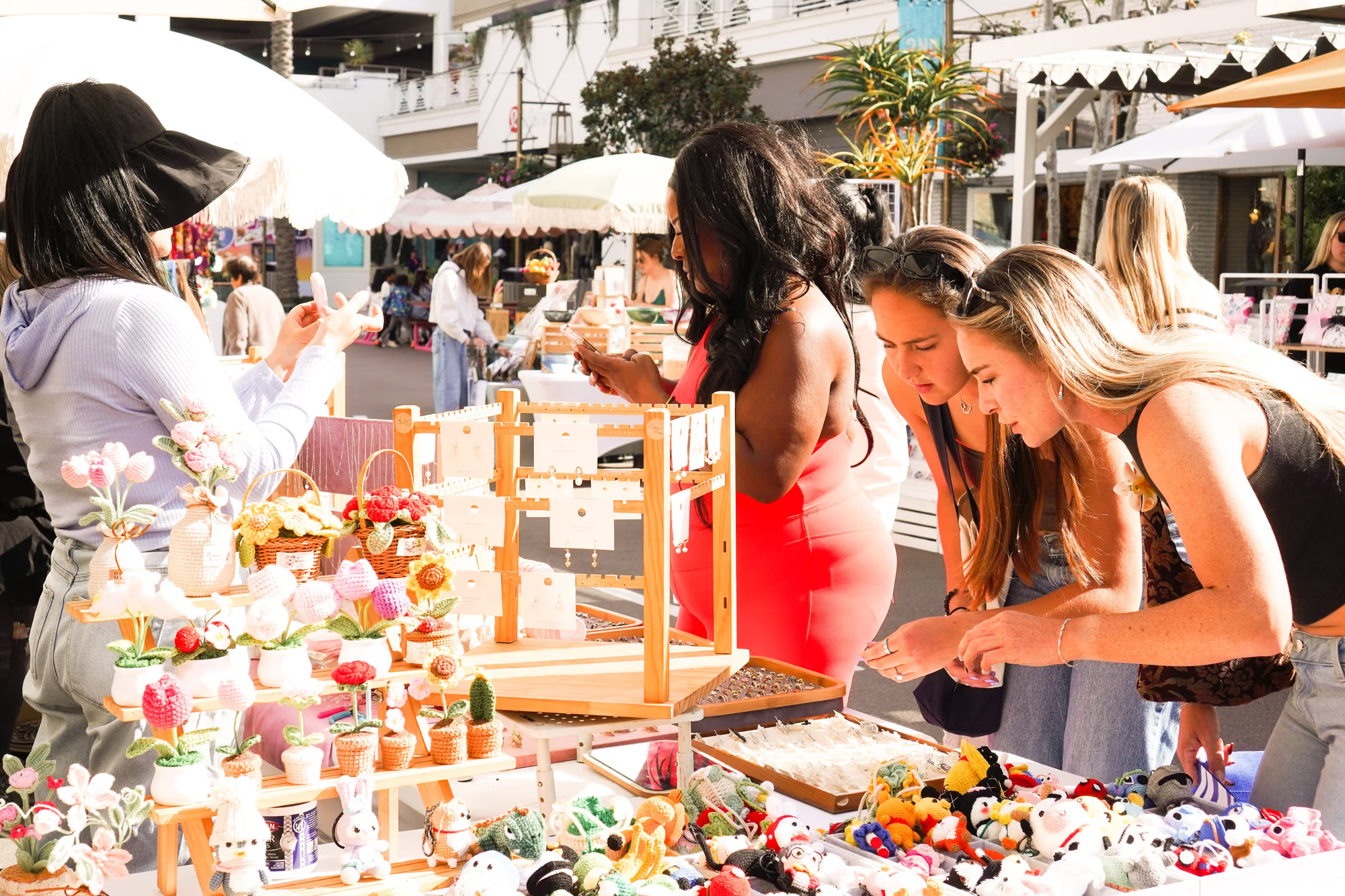
No two markets are identical, and we curate each one for its venue and crowd. But across our markets a recognizable mix has emerged — the categories that, together, make a market feel full. Presented qualitatively, in rough order of how often you will see them walking the aisles:
- Handmade goods and home décor — candles, ceramics, woodwork, textiles, and the small original objects people buy to keep or to gift.
- Jewelry and accessories — one of the most consistent draws at nearly every market, from delicate everyday pieces to bold statement work.
- Apparel and wearables — independent clothing labels, hand-printed tees, hats, and bags.
- Vintage and resale — curated secondhand clothing, records, and collectibles, a category that has grown noticeably across our run.
- Plants and botanicals — succulents, houseplants, and dried arrangements that turn a corner of the market green.
- Art and prints — original work, prints, stickers, and paper goods from local artists.
- Food and drink — packaged treats, baked goods, beverages, and prepared food that give a market its smell and its pace.
The through-line is that shoppers come for discovery, not errands. They are there to find the thing they did not know existed — an original piece from an independent maker, made to be kept. That is what keeps the mix broad and the crowd curious.
Regional map
Four regions, distinct personalities.
Orange County
The heartland.
Our densest region. Signature venues include Old Town Tustin, Bella Terra in Huntington Beach, Westcliff Plaza in Newport Beach, and Rancho Santa Margarita. Design-conscious, gift-driven crowds and a strong appetite for quality handmade goods. Orange County markets →
Los Angeles
The stage.
Anchored by Grand Central Market in Downtown LA — high foot traffic, a diverse and trend-forward crowd, and the visibility that comes with a landmark location in the heart of the city. Los Angeles markets →
San Diego
The waterfront.
Centered in Little Italy at Piazza della Famiglia and Liberty Public Market. Walkable, food-forward destinations where tourists and locals mix and lingering is the whole point. San Diego markets →
Long Beach
The coast.
Hosted at 2nd & PCH — an open-air waterfront setting that draws a relaxed, coastal crowd and rounds out our reach across the SoCal map. Long Beach markets →

Seasonality
When the calendar heats up.
Markets run Thursday through Sunday across our regions, and the year has a clear shape. Two stretches carry the most energy on our calendar.
Summer is peak season. Long daylight, warm evenings, and vacation rhythms pull the biggest, most consistent crowds. From late spring through the end of summer, the markets are at their fullest and the mood is unmistakably festival.
Q4 holidays are the second surge. From late fall into December, shoppers arrive with gift lists, and the handmade mix — jewelry, home goods, art, small-batch food — is exactly what they are hunting for. It is the season where a single strong market can carry a small business through the quarter.
The shoulder months still deliver — Southern California weather rarely forces a cancellation — but summer and the holidays are where the crowds and the sales concentrate.
What it means for small business
The opportunity, plainly.
For an independent maker, the math of a pop-up market is hard to beat. There is no lease, no build-out, and no long-term risk — you show up for a day and meet real customers in front of your table. A market is a storefront you can rent for an afternoon, in a plaza that already has foot traffic you would spend months building online.
What we have watched over five years is that the makers who treat markets as a channel, not a one-off, tend to compound. They meet repeat customers, build a local following, test new products against live reactions, and turn a Saturday crowd into an email list and a set of regulars. For many of the small businesses that have vended with us, the market was the first place a stranger became a customer.
The barrier to entry is genuinely low: admission is free for shoppers, and applying to vend costs nothing. Each market is its own approval, curated for its venue and crowd — so the opportunity is not "get in once," it is "find the markets where your work belongs and show up." For a region full of makers who started online and want to be seen in person, Southern California's market calendar has become one of the most accessible on-ramps to real customers there is.
For Vendors
Want to be part of the next chapter?
If you make something worth keeping, there is a market for it across our four regions. Browse the calendar, find the dates that fit your brand, and apply — free, one market at a time.
Apply to vend →Frequently asked